How to Read Red Light Panel Specs Without Falling for the Numbers
How to Read Red Light Panel Specs Without Falling for the Numbers
Scroll through any red light panel listing and you will see the same confident numbers: 150+ mW/cm², five or six wavelengths, "medical grade." Spend ten minutes in r/redlightpanels and you will see the same numbers torn apart, post after post. Both things can be true at once — the numbers are real, and they are also meaningless the way most brands present them.
The gap between the spec sheet and what actually reaches your skin is the single biggest source of buyer's remorse in this hobby. So let's walk through the four numbers that matter, what they hide, and how to sanity-check any panel — including ours — before you spend money.
Irradiance: the number everyone quotes and almost nobody measures honestly
Irradiance (mW/cm²) is how much light power lands on a given area. It is the spec most brands shout loudest, and the one most often distorted. The r/redlightpanels crowd has a name for the trick: the 0-inch measurement. A panel held directly against a sensor reads far higher than the same panel at the distance you will actually use it — light intensity falls off fast as you step back. A figure like "150 mW/cm²" measured at the LED surface tells you almost nothing about what your skin receives at 6 or 12 inches.
A cheap light meter can also overestimate red and near-infrared output dramatically, which is why two brands with identical hardware can print wildly different numbers.
❓ Q: What irradiance should I actually look for?
Aim for roughly 20–100 mW/cm² at the distance you will genuinely use — most home routines happen at 6–12 inches. A brand that publishes its measurement distance (and ideally an independent test) is showing its work; a brand that only quotes one huge number with no distance is hiding it. We list irradiance on every panel and mat page for exactly this reason.
Wavelengths: 660 and 850 are the foundation, the rest is garnish
The consensus basics have not moved in years: 660nm red for surface skin, 850nm near-infrared for deeper muscle and joint work. Those two cover nearly everything a home user wants.
Brands keep adding more wavelengths — 630, 810, 830 — and billing five-wavelength arrays as an upgrade. Sometimes they are; more often they dilute power across diodes to chase a marketing bullet point. Adding wavelengths is only useful if the total power output holds.
❓ Q: Is a five-wavelength panel worth paying extra for?
For most home users, no. A solid 660+850 device covers skin and deeper tissue; a well-built two-wavelength unit beats a poorly cooled five-wavelength one every time. Judge the build and the power first, the wavelength count second.
Coverage and form factor: the trade-off nobody warns you about
A bigger array spreads light over more of your body in one session. A smaller one concentrates power on a target area and fits a desk. Neither is "better" — they answer different questions. What matters is matching the form factor to your routine, not buying the biggest box.
That is the honest way to frame the mat-versus-panel decision too, and it deserves more space than a paragraph, so we wrote a full comparison of panel and mat layouts for different routines.
❓ Q: Does a small desktop panel even "work"?
For targeted areas — face, hands, one knee, one shoulder — yes, with realistic session times. What a small panel cannot do is treat your whole body at once. Consistency in a small zone beats an occasional full-body blast that never happens.
Power supply and heat: the boring spec that decides lifespan
LEDs generate heat; heat degrades LEDs and burns skin contact time. Panels with decent cooling can run higher output without cooking you at 6 inches. Flexile pads and mats trade some peak power for skin contact and portability. None of this shows up in a headline number, but it decides whether the device is pleasant to use daily or ends up in a drawer by March — the most common fate of impulse buys in this community.
Putting it together: what our own numbers look like
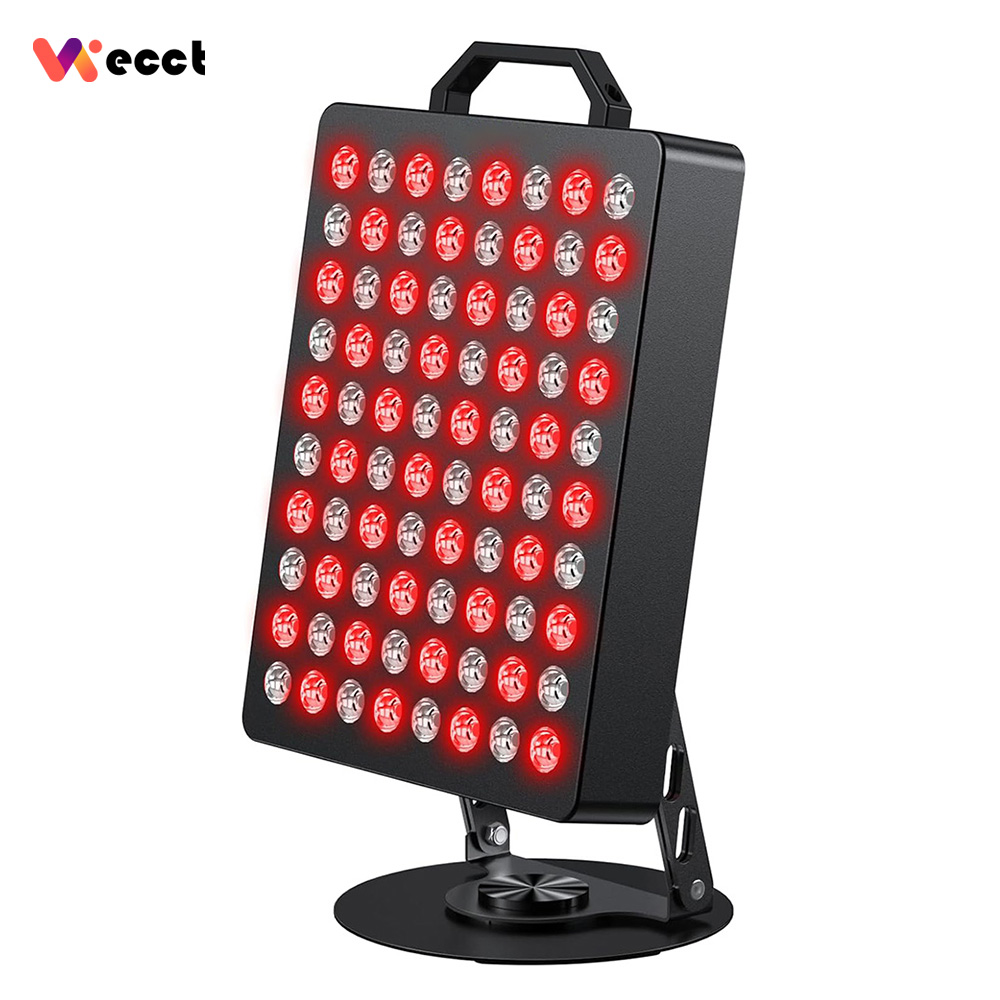
We would rather show the math than shout it. Our 80 LED desktop panel publishes its irradiance at a stated working distance, runs 660+850nm, and weighs about as much as a bag of sugar — built for face, neck, and targeted spots. If you want full-body contact instead, the 770 LED mat and the larger 1410 LED mat take the same dual-wavelength approach in a lie-down format. For a full walkthrough of how these choices fit together at home, our guide to choosing a home red light device covers the rest — and if you would rather judge by how a device fits your day than by its numbers, the panel-versus-mat routine comparison makes that case in detail.
FAQ: Quick Answers
Q: How long should a session last on a typical home panel?
Ten to twenty minutes per area at a working distance of 6–12 inches is the common home range. Start shorter during your first weeks and build up. If the panel feels hot on your skin, step back rather than shortening the timer.
Q: How close should I sit to the panel?
For facial and targeted work, 6–12 inches is typical. Skin contact is only needed with pads and wraps designed for it. Double the distance and you cut intensity to roughly a quarter — distance is a dose dial.
Q: Can I overdo red light sessions?
More is not better. Long daily sessions at close range can push past the useful dose range and irritate skin. Three to five sessions a week of moderate length is the sustainable pattern most users settle into.
Q: What warranty should I expect?
Two to three years is standard from established brands. Warranty length is also a quiet signal of how much the maker trusts its own cooling and power design — a device expected to fail at year one rarely carries a three-year promise.
Q: Do I need goggles?
Yes when the device points at or near your face. Visible red light is not dangerous in brief exposure, but staring at a bright array is uncomfortable and pointless. Every WECCT panel and mask ships with eye protection for good reason.
References
- Cleveland Clinic, Red Light Therapy overview — https://my.clevelandclinic.org/health/treatments/26562-red-light-therapy
- Hamblin MR, "Photobiomodulation for the brain" (PMC review incl. dose window discussion) — https://pmc.ncbi.nlm.nih.gov/articles/PMC10840571/
Continuar lendo
Red Light Therapy Devices for Home: 660nm, 850nm, and How to Choose
Learn how 660nm red and 850nm near-infrared light work, compare five device formats, and choose the right red light therapy device for home.
Adjustable Straps and Roll-Up Storage in a Home Red Light Therapy Mat
A red light therapy mat earns a place in a daily routine when it stays put and stores easily, and the straps and roll-up body decide most of that.
Red Light Therapy for Lower Back Muscle Tension at Home
A home red light mat can support a daily lower-back comfort routine, but it belongs in wellness use, not medical treatment.